Posts

Showing posts with the label Cool Japan

My video interview with German TV (DW Deutsch / Deutsche Welle): How AI could save Anime

Image
<<1:54 AI can help maintain the anime boom, says Roland Kelts, Professor and 1:58 Japanese culture expert. 1:59 He has written a book about anime. 2:02 "They call it 'in-betweener work,' when you draw frames in 2:07 between the keyframes. 2:09 And that kind of work can be done by AI very effectively and save the 2:13 studios money and time. 2:16 A lot of people think of anime as these big hits, etc. 2:20 But there are thousands of anime produced every year. 2:23 And many of them are just for late-night TV. 2:25 They are pretty cheap, so those can probably easily be produced by AI." 2:33 Technology isn’t seen as a threat in Japan, says Kelts. 2:37 This openness is rooted in the country’s indigenous 2:40 religion, Shinto. 2:41 Shinto is centered on worshipping kami, or spiritual entities. 2:45 They inhabit all kinds of objects, manmade or not, and everything is 2:49 accepted to be part of nature. 2:52 "Japanese creativity is quite fluid. 2:54 The very first a...
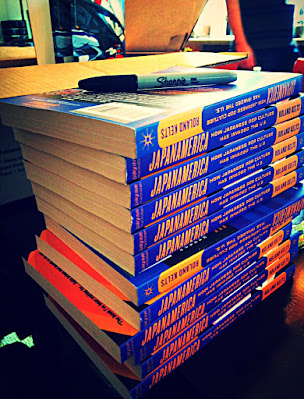
JAPANAMERICA chosen for "100 Books for Understanding Contemporary Japan"

Image
Thanks to the Nippon Foundation for the honor of being a chosen book .

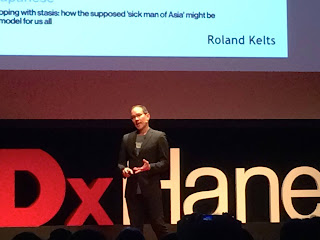
TEDx Talk on Japanese Culture at Haneda Airport, Tokyo

Image
Back when you still could, I gave a talk for TEDxTokyo in a hangar at Haneda Airport. The topic was "Cool Japan." But this time I didn't talk about anime, manga, video games or fashion. Instead I focused on core cultural values expressed in Japanese words such as jishuku (restraint, discipline), gaman (endurance and perseverance amid adversity), ganbaru (to fight on, keep at it, stand firm) and wa (seeking and maintaining communal harmony). I didn't know then that such values would serve Japan well during a global pandemic. It was a remarkable event. At the reception there were canapes and wine and we watched a guitarist bring the sun down near the nose of a plane. Now it all seems surreal and, sadly, would be impossible. (Video of my presentation has been posted here .)

Anime Cons are canceled, from SDCC to AX to Otakon

Image
Anime cons ‘will never be the same’ after the coronavirus The Japan Times [*Since the publication of this story, San Diego Comic-Con, Anime Expo, Otakon, and other major pop culture conventions have been canceled. Some have moved online to host virtual events. Project Anime provides a list .] The anime convention season, usually in full swing from March through the end of summer, has been decimated by the spread of the novel coronavirus. Hundreds of events held annually across the globe, from Paris and Seattle to Toronto and Tokyo, most of which attract thousands of guests, are now canceled or postponed. Some of them won’t come back. The cascade of announcements started in Tokyo at the end of February. AnimeJapan, usually held in March and the industry’s only major yearly trade fair, was abruptly called off on Feb. 27, one day after the government’s request to avoid large-scale gatherings. At the time, the decision felt rushed and a bit rash. A list of performers...

2019: A revolutionary year for the US anime business

Image
U.S. anime market matures in 2019 The Japan Times The third annual Animation Is Film Festival kicked off on Oct. 18 in Los Angeles with the United States premiere of Makoto Shinkai’s latest Japan box-office hit, “Weathering With You,” followed by an onstage Q&A with Shinkai, who flew in from Tokyo for the event. Demand for tickets was so fierce that organizers added a second overflow screening at the city’s historic TCL Chinese Theater on Hollywood Boulevard. According to festival founder Eric Beckman, CEO of U.S. distributor GKIDS, tickets to the second screening sold out in “less than three minutes.” WEATHERING WITH YOU, image courtesy of GKIDS /  ©2019 “Weathering With You” Film Partners Six years after the global anime industry was jolted by the retirement of its most loved and bankable artist, Studio Ghibli director Hayao Miyazaki, developments in the North American market are transforming 2019 into a banner year. Through consolidation, the flowerin...

Anime's aging artists keep going: Mamoru Oshii (Ghost in the Shell) has a new series

Image
Anime's aging but active artists: Mamoru Oshii on his latest project, 'Vladlove' The Japan Times Writer and director Mamoru Oshii is best known for creating sci-fi thrillers that challenge orthodoxy with their philosophical musings and provocative, often nutty, imagery. His most famous film, the 1995 anime epic “Ghost in the Shell,” features a stone-cold cyborg heroine who dives nude off a skyscraper and is memorably dismembered by a tank. But at a Tokyo press conference last week to introduce his latest project, a 12-episode slapstick comedy series titled “Vladlove,” all Oshii wanted to talk about was girls. Real ones. And a vampire named Mai. “This time I wanted to take on a girl-meets-girl story,” he said. “The main characters are five schoolgirls. There won’t be any hot guys.” Oshii is the series’ creator and chief director, working with fellow anime veteran Junji Nishimura (“Ranma ½”). Financed by Ichigo Animation, a newly formed subsidiary of a rea...

Why Hollywood doesn't get Anime

Image
Why Hollywood doesn't yet get anime The Japan Times No fewer than three big-budget Hollywood films based on Japanese originals opened this year: “Alita: Battle Angel,” “Pokemon Detective Pikachu” and “Godzilla: King of the Monsters.” While all three were still being promoted, “Gundam” and “Akira” were green-lit for production by Legendary Entertainment and Warner Bros., respectively. An adaptation of Sega’s Sonic the Hedgehog video game will be out in November, followed by Hollywood takes on Capcom’s Monster Hunter next year and Nintendo’s Super Mario in 2022. The highest grossing anime feature ever, Makoto Shinkai’s 2016 “Your Name.,” is being remade as a live-action film, produced by “Star Wars” reboot king, J.J. Abrams. Hollywood renderings of “Attack on Titan” and the iconic mascot Hello Kitty are also reportedly on the way. But so far, Hollywood’s versions of Japanese content have received mixed reviews at best, with some earning respectable but not remarkable...

My hero, ULTRAMAN, hits Netflix as anime

Image
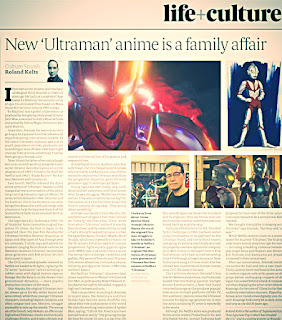
New 'Ultraman' anime is a family affair The Japan Times I first met anime director and mechanical designer Shinji Aramaki in Tokyo 12 years ago. He had just completed “Appleseed: Ex Machina,” the second in a trio of epic CG-animated films based on Masamune Shirow’s four-volume 1985 manga. “Ex Machina” was a global collaboration: co-produced by Hong Kong/Hollywood director John Woo, costumed by Italy’s Miuccia Prada and scored by Yellow Magic Orchestra’s Haruomi Hosono. Since then, Aramaki has become anime’s go-to guy for Japanese franchise reboots and sequels targeting international markets. As the nation’s domestic audience ages and its youth population shrinks, producers are scrambling to dust off older titles that might resonate both at home and abroad. That has them going to Aramaki a lot. Now 58 and the father of two adult daughters, he is currently working alongside screenwriter/director Kenji Kamiyama on anime adaptations of 1989’s “Ghost in the Sh...

Haruki Murakami at 70: my latest interview

Image
Still swinging for the fences: Murakami in conversation The Times Literary Supplement “You see, I’m like a cat”, he tells me, twice. “I know the best position, and I go there straight. And I do it on my own time. Many people don’t like that about me.” Despite Murakami’s discomfort in Japan, and the disdain he receives from Japanese literary critics ten or more years his junior, his legacy is everywhere in contemporary Japanese culture. He’s there in the unvarnished prose and surreal happenstance in the work of younger writers, including Sayaka Murata (whose bestselling Convenience Store Woman is an eerily Murakamiesque blend of the magical mundane punctuated by violence) Mieko Kawakami and Hideo Furukawa (who wrote what he calls “a remix” of an early Murakami story, entitled Slow Boat ), all of whom claim that his model as an independent, uncompromising artist forged their paths from the parochial forests of Japanese letters to the broader plains of world literature. The...

Why Hayao Miyazaki is back

Image
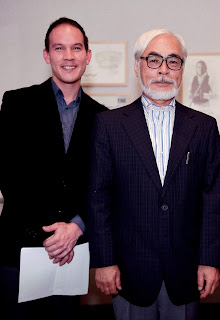
Hayao Miyazaki: The never-ending story Last week, an NHK documentary chronicling Hayao Miyazaki’s retirement and un-retirement, “Never-Ending Man: Hayao Miyazaki” opened in select theaters across the United States. The same day on the other side of the world, his 1988 classic “My Neighbor Totoro” was released for the first time in theaters across China — 6,000 of them. Next month, Miyazaki will receive the Los Angeles Film Critics Association’s Career Achievement Award. In 2019, also in LA, the largest-ever exhibition of his work will inaugurate the prestigious Academy Museum of Motion Pictures. Meanwhile, in Japan, Tokyo’s Shinbashi Enbujo Theater will stage a kabuki version of “Nausicaa of the Valley of the Wind,” Miyazaki’s 1984 sci-fi epic. And 2020 (or soon after) will see the premiere of “How Do You Live?,” his 12th feature film, followed by the opening of a Studio Ghibli theme park near Nagoya. Miyazaki held a press conference to announce his retirement in Septembe...

JAPANAMERICA named one of the 5 best English-language books on Japanese culture

Image
We're honored to be with Haruki Murakami, Hayao Miyazaki, Frederik L. Schodt & Susan J. Napier.  Happy holidays.

DEVILMAN CRYBABY & AGGRETSUKO: Chats w/Go Nagai, Masaaki Yuasa and Netflix's Taito Okiura

Image
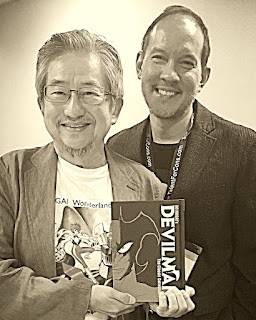
Netflix anime welcomes the dark side Go Nagai is the original bad boy of manga. His series “Shameless School” (“Harenchi Gakuen”) cemented his status as the inventor of the hentai (erotic) genre. “Shameless School” debuted in the first issue of Shueisha Inc.’s Weekly Shonen Jump , Japan’s best-selling manga magazine, in August 1968. The adult shenanigans and sexualized students Nagai depicted rendered him the target of national media, Parent Teacher Associations and women’s groups — and an infamous artistic pioneer. Over the past year, both Nagai and Shonen Jump have been celebrated for their 50th anniversary milestones. But one of Nagai’s later manga has gained immediate relevance. The animated adaptation of his 1972 “Devilman” series, “Devilman Crybaby,” directed by Masaaki Yuasa and released on Netflix back in January, has become one of 2018’s most talked-about anime and biggest international hits, despite its source being 46 years old. Now 73, Nagai looks like a profess...

Live in Dubai at the 25th Sharjah International Book Fair 2018

رولاند كيلتس يتحدث إلينا خلال مشاركته في معرض الشارقة الدولي للكتاب Roland Kelts, well-known speaker and author chats with us. Here's what he said about #SIBF18 and about his participation. #الشارقة #الإمارات #معرض_الشارقة_الدولي_للكتاب #Shj #UAE #SBA pic.twitter.com/xpmg3QSUik — Sharjah Book Authority (@SharjahBookAuth) November 9, 2018

Manga & anime in Japan's Heisei era (1989 - 2019)

Image
Defining the Heisei Era: When anime and manga went global The Heisei Era commenced after two gods fell in rapid succession. The first, Emperor Hirohito, was no longer officially a god, having repudiated his quasi-divine status under the terms of Japan’s surrender in World War II, but he remained god-like in stature. His January death in 1989 at age 87 signaled the end of a Showa past both turbulent and glorious. It drew global attention from the world’s leaders and media, but had been widely anticipated in Japan. The other fell just one month later, in February, and his death shocked the nation. Osamu Tezuka, the beloved “god of manga,” died of stomach cancer at the age of 60. News of his declining health had been kept secret, as was then customary in Japan. Tezuka was a prolific workaholic and omnipresent television personality. He was also a licensed physician. Almost no one expected his sudden passing. The two deaths would augur a new life for Japan’s twin pop cultu...

Me and my Monkey: my story behind Monkey Business: New Writing from Japan

Image
via GLLI Editor’s note: Forget the old saw that English language readers won’t read literature in translation. For the last seven years, Monkey Business: New Writing from Japan has been publishing an annual journal of what it calls “the best of contemporary Japanese literature” in English. The paperback editions of the first three issues were completely sold out. This year, though, for reasons the editors call “both professional and personal,” it will not be releasing a new edition. Monkey Business will return with issue no. 8 in 2019 but the digital and most paperback editions of issues 1-7 are available for purchase at its online store . I asked Roland Kelts, who has been involved with the journal since its founding, to tell us about Monkey Business and his connection to Japanese literature in translation.   Eight years ago I had the good fortune of being asked to do a favor. Professors Motoyuki Shibata and Ted Goossen, esteemed literary translators, invited me to di...
Image
Honored to be visiting Akita, my grandmother Ebata's furusato (hometown), to speak at Akita International University .

MANGA & MURAKAMI

Image
Japan’s pop culture and literature drive soft power Anime, manga and Haruki Murakami may form an unlikely trinity, but outside of Japan they’re responsible for filling Japanese Studies departments and sprawling convention halls with generations of the devoted. They’re at the core of Japan’s global allure, the center of its soft power, and last month I was immersed in all three in the span of two weeks in two countries: the United Kingdom and the United States. In Japan they’ve been around for decades, yet they continue to draw younger audiences abroad. It was 40 years ago that Murakami decided he could write a novel after watching an American baseball player hit a double for the Yakult Swallows, his favorite Japanese team. That novel, 1979’s “Hear the Wind Sing,” won Japan’s Gunzo Prize for New Writers and launched the literary career of a rarity: a bona-fide international best-selling writer who is now short-listed annually for the Nobel Prize in literature. Twenty years...

Thank you, Columbia University Alumni Japan

Image
My generous thanks to Hajime Kosai, my fellow Japan alum from Columbia University, and a brilliant audience at Aux Bacchanales in Tokyo. Hope to see you in the UK & US next month. (photos: Hajime Kosasi)

Live talk for Columbia Alumni Association of Japan, Feb. 8

Image
I'm honored to be joining fellow Columbia grads in Tokyo for a talk & Happy Hour on Thursday, February 8th, 7 - 9 p.m., at Aux Bacchanales, Kioicho,  Shin Kioicho Bldg. 1F, 4-1 Kioicho, Chiyoda-ku, Tokyo  (at Hotel New Otani ). Info & rsvp here .

On the death of Japan's game industry, for The Japan Times

Image
Localization: Has Japan lost the plot? By ROLAND KELTS Japan once ruled and defined the global gaming industry. In the arcade age, Japanese developers gave us “Pac-Man,” “Space Invaders” and “Donkey Kong.” In the era of physical consoles: “Metal Gear Solid,” “Snatcher,” “Final Fantasy” and “Silent Hill.” Japan’s creative use of technology, physical design and narrative whimsy once made it the only country in the world that consistently delivered interactive pleasures via buttons and joysticks. But as veteran American translator, localizer and voice director Jeremy Blaustein reminds me, that was a very long time ago. Since then, the Japanese gaming industry has grown increasingly marginal in the global market. Costs have soared, technologies advanced exponentially and the Americans overtook the business. Speaking at the Tokyo Game Show in 2009, game creator Keiji Inafune was unequivocal: “Japan is over,” he said. “We’re done. Our game industry is finished.”