Posts

Showing posts with the label Japanese literature

New chat w/Haruki Murakami for The Nikkei

Image
Movie animates Murakami's portraits of empty lives     American writer Nathaniel Rich once claimed that Haruki Murakami, lauded internationally and regularly short-listed for the Nobel Prize in literature, actually writes "genre fiction," the commercial label for stories that repeat formulas, conventions, plots and sometimes whole casts of characters to satisfy reader expectations (think "Game of Thrones" or "Harry Potter"). Genre works are distinguished from the less predictable and less marketable aims of literary fiction -- and have a much better shot at the bestseller list. The kicker, according to Rich, is that Murakami created his own genre, absorbing literary conceits into a blend of other recognizable storytelling tropes from the realms of noir, fantasy, horror and sci-fi. The most salient hallmark of the Murakami genre is its fluid shifts between a ruthlessly humdrum reality and poetic, often borderline erotic and prophetic dreamworlds. These ...

Two talks in October: MONKEY Launch and A Conversation with Mieko Kawakami

Image
I'll be participating in two public events next month, one of which may have a live audience in addition to Zooming heads. Hope you'll join us, online or off.  •    Saturday 10/10, 10am - 12 pm Japan Standard Time (Friday 10/9, 9pm - 11 pm EST, 6pm - 8pm PST): Voices from Japan: Launching the New Literary Journal MONKEY , with Motoyuki Shibata, Tomoka Shibasaki, Hideo Furukawa, Satoshi Kitamura, Ted Goossen, Meg Taylor, Polly Barton and Jordan Smith. Hosted by Hitomi Yoshio at Waseda University. Click here to register. •      Sunday 10/18, 10am - 11:30 am Japan Standard Time (Saturday 10/17, 9pm - 10:30 pm EST, 6pm - 7:30pm PST):  Mieko Kawakami (BREASTS AND EGGS) in conversation with Roland Kelts (JAPANAMERICA) , with Motoyuki Shibata (introduction) and Hitomi Yoshio (interpretation). Hosted by International House Japan and The Asia Society. Click here to register.

JAPANAMERICA chosen for "100 Books for Understanding Contemporary Japan"

Image
Thanks to the Nippon Foundation for the honor of being a chosen book .

Donald Keene, 1922 - 2019

Image
Writers recall their initiation to Japanese literature via Donald Keene   The Japan Times Roland Kelts, author: Bookforum asked me to review Donald Keene’s memoirs , “Chronicles of My Life: An American in the Heart of Japan.” I said yes and winced. Keene was in his 80s at the time and had a lot of life to remember. His book would be massive. But then he, too, was vast: a bridge from my America to my Japanese mother’s land and literature. Also, a graduate of and professor emeritus at my alma mater, Columbia University, whose Center of Japanese Culture bears his name. A slim package arrived: 200 pages. In one chapter, Keene jet-sets around Europe, lobbying for Mishima’s Nobel, when his mother falls ill in New York. He arrives at her bedside too late. She can no longer speak. One cannot live and love in two worlds at once, he observes. The chapter closes so softly I had to put the book down and stare at the wall, shaken. Keene did what Kafka asks of writers: Ax the fr...

Haruki Murakami at 70: my latest interview

Image
Still swinging for the fences: Murakami in conversation The Times Literary Supplement “You see, I’m like a cat”, he tells me, twice. “I know the best position, and I go there straight. And I do it on my own time. Many people don’t like that about me.” Despite Murakami’s discomfort in Japan, and the disdain he receives from Japanese literary critics ten or more years his junior, his legacy is everywhere in contemporary Japanese culture. He’s there in the unvarnished prose and surreal happenstance in the work of younger writers, including Sayaka Murata (whose bestselling Convenience Store Woman is an eerily Murakamiesque blend of the magical mundane punctuated by violence) Mieko Kawakami and Hideo Furukawa (who wrote what he calls “a remix” of an early Murakami story, entitled Slow Boat ), all of whom claim that his model as an independent, uncompromising artist forged their paths from the parochial forests of Japanese letters to the broader plains of world literature. The...

JAPANAMERICA named one of the 5 best English-language books on Japanese culture

Image
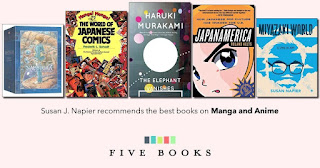
We're honored to be with Haruki Murakami, Hayao Miyazaki, Frederik L. Schodt & Susan J. Napier.  Happy holidays.

Live in Dubai at the 25th Sharjah International Book Fair 2018

رولاند كيلتس يتحدث إلينا خلال مشاركته في معرض الشارقة الدولي للكتاب Roland Kelts, well-known speaker and author chats with us. Here's what he said about #SIBF18 and about his participation. #الشارقة #الإمارات #معرض_الشارقة_الدولي_للكتاب #Shj #UAE #SBA pic.twitter.com/xpmg3QSUik — Sharjah Book Authority (@SharjahBookAuth) November 9, 2018

Me and my Monkey: my story behind Monkey Business: New Writing from Japan

Image
via GLLI Editor’s note: Forget the old saw that English language readers won’t read literature in translation. For the last seven years, Monkey Business: New Writing from Japan has been publishing an annual journal of what it calls “the best of contemporary Japanese literature” in English. The paperback editions of the first three issues were completely sold out. This year, though, for reasons the editors call “both professional and personal,” it will not be releasing a new edition. Monkey Business will return with issue no. 8 in 2019 but the digital and most paperback editions of issues 1-7 are available for purchase at its online store . I asked Roland Kelts, who has been involved with the journal since its founding, to tell us about Monkey Business and his connection to Japanese literature in translation.   Eight years ago I had the good fortune of being asked to do a favor. Professors Motoyuki Shibata and Ted Goossen, esteemed literary translators, invited me to di...

Is manga dying in Japan?

Image
Will digital piracy ruin the future of manga? Chigusa Ogino (photo: Toru Takeda) Author and manga translator Frederik L. Schodt once pointed out to me that many of Japan’s cultural products are embraced abroad just as they are declining at home. Ukiyo-e prints became the rage in Europe in the late 19th century, nearly 100 years after they’d peaked in Edo and Kyoto. Sake sales have been climbing steadily in overseas markets, with the value of exports doubling over the past five years and hitting a record in 2017, as they continue a decades-long slide in Japan. And now: manga? According to a survey by the Research Institute for Publications, domestic manga sales were flat last year, but the big reveal in the numbers was that digital outsold physical for the first time, rising 17.2 percent while print slipped 14.4 percent. Weekly manga magazines saw the steepest drop in sales, to below a third of what they were in 1995. A lot of digital manga content is cheap or costs nothing at ...

Keynote gig, Los Angeles, July 2018

Image
Writer, scholar, editor and cultural critic Roland Kelts  is the author of the critically acclaimed and bestselling book, JAPANAMERICA: HOW JAPANESE POP CULTURE HAS INVADED THE U.S. His writing is published in the US, Europe and Japan in The New Yorker, The Guardian, The Wall Street Journal, The New York Times, Time Magazine, Harper’s Magazine, The Japan Times and many others. He contributes commentary on Japan to CNN, the BBC, NPR and Japan’s NHK, and gives talks at venues worldwide, including The World Economic Forum, TED Talks, Harvard University, the University of California, the University of Tokyo, the Singapore Writers Festival and several anime conventions across the United States. He has interviewed several notable Japanese artists, including Hayao Miyazaki and Haruki Murakami, and is considered an authority on Japanese culture and media. Kelts has won a Jacob K. Javits Fellowship Award in Writing at Columbia University and a Nieman Fellowship in Journalism at...

MANGA & MURAKAMI

Image
Japan’s pop culture and literature drive soft power Anime, manga and Haruki Murakami may form an unlikely trinity, but outside of Japan they’re responsible for filling Japanese Studies departments and sprawling convention halls with generations of the devoted. They’re at the core of Japan’s global allure, the center of its soft power, and last month I was immersed in all three in the span of two weeks in two countries: the United Kingdom and the United States. In Japan they’ve been around for decades, yet they continue to draw younger audiences abroad. It was 40 years ago that Murakami decided he could write a novel after watching an American baseball player hit a double for the Yakult Swallows, his favorite Japanese team. That novel, 1979’s “Hear the Wind Sing,” won Japan’s Gunzo Prize for New Writers and launched the literary career of a rarity: a bona-fide international best-selling writer who is now short-listed annually for the Nobel Prize in literature. Twenty years...

"40 Years of Haruki Murakami" conference at Newcastle University, UK, March 6 - 10

Image
Honored to be joining friends and colleagues in Newcastle, UK for "Eyes on Murakami," a symposium on the 40th anniversary of Haruki Murakami's life in fiction.

"Brand Japan" talk in Tokyo at International House of Japan, April 24

Image
Honored to be returning to Tokyo for my second talk at International House of Japan, April 24. Register here  for tix.

Monkey tour complet, 4/26 - 5/8 2015

Image
MONKEY BUSINESS US MIDWEST AND NEW YORK 2015 SPRING TOUR   MIDWEST With: Aoko Matsuda Satoshi Kitamura Susan Harris (4/28) April 27 (Mon.) – Chicago, IL: Columbia College-Chicago, 1:00 – 5:00 pm April 28 (Tue.) – Chicago, IL: University of Chicago, 4:30 – 8:00 pm April 29 (Wed.) – Kalamazoo, MI: Western Michigan University (Kalamazoo), 4:30pm~ April 30 (Thur.) – Madison, WI: The University of Wisconsin (Madison), 5:00 – 7:00pm NEW YORK With: Aoko Matsuda Satoshi Kitamura Ben Katchor (5/3 – 5/6) Kelly Link (5/4 & 5/6) Jay Rubin (5/7) May 3 (Sun.) – Brooklyn, NY: BookCourt, 4:00pm~ May 4 (Mon.) – New York, NY: Asia Society, 6:30pm~ May 6 (Wed.) – New York, NY: McNally Jackson, 8:00pm~ May 7 (Thur.) – New York, NY: Japan Society, 6:30pm~

California MONKEY Tour starts now @San Diego

Image

On tour in California, Oct. 2014

Image
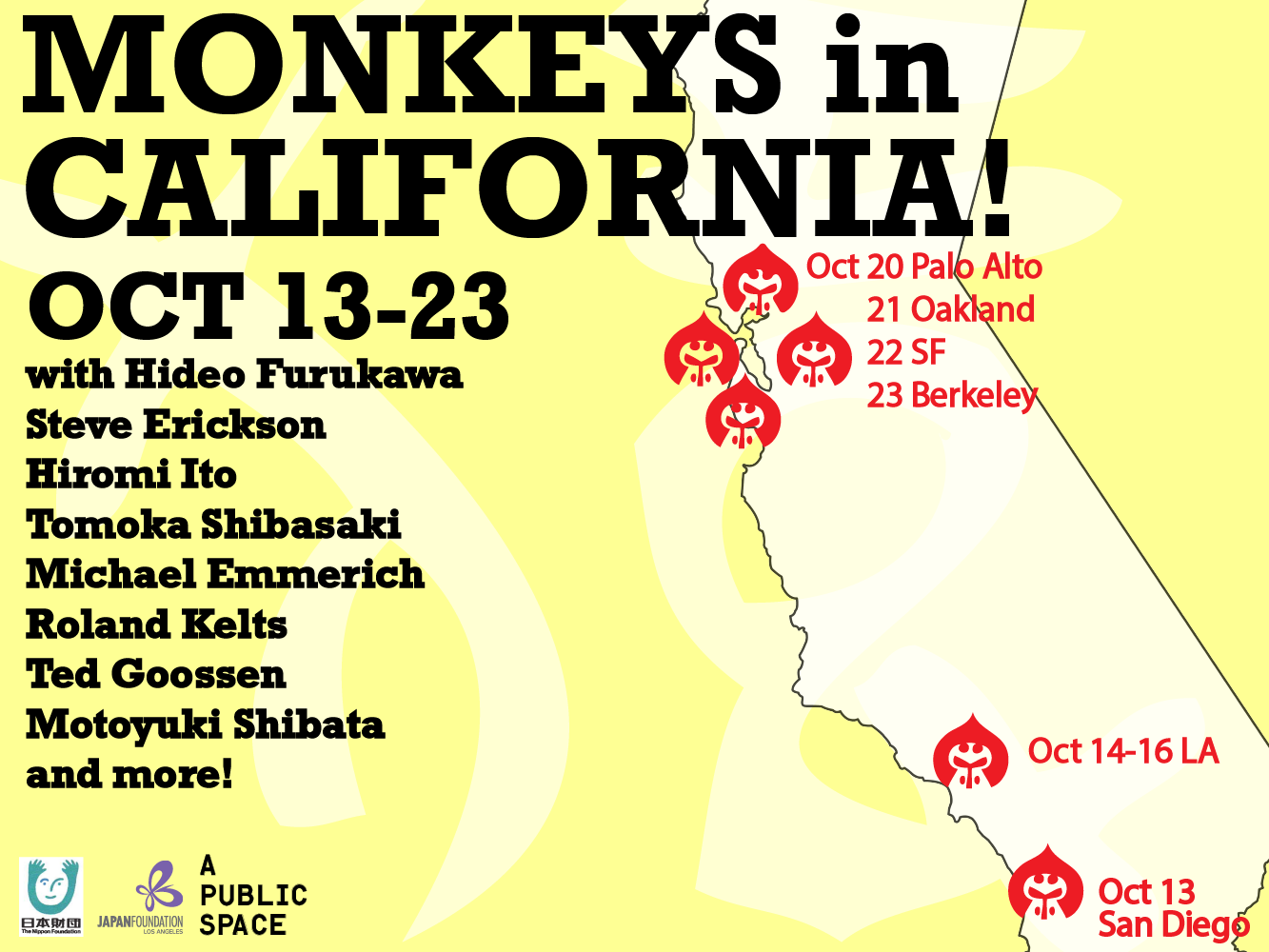
I'll be touring California with the Monkey Business team next month, Oct. 11 - 25. Six cities -- San Diego, Los Angeles, Palo Alto, Oakland, San Francisco and Berkeley -- w/Tomoka Shibasaki, Hideo Furukawa, Steve Erickson, Hiromi Ito, Peter Orner, Dean Rader, Motoyuki Shibata, Ted Gooossen and more. Readings, signings, conversation, fine wines & spirits. [Sayaka Toyama, graphic] Specs after the jump.

On the real Haruki Murakami -- my interview with Penguin Random House Canada

Image
Here .

COOL JAPAN: New monthly column for the American Chamber of Commerce in Japan

Image
COOL JAPAN | BEGINNINGS  ( ACCJ Journal ) Cultures Intertwined American influence on Japan’s soft-power push By Roland Kelts In 2002, American journalist Douglas McGray published an article in Foreign Policy magazine called “Japan’s Gross National Cool.” After spending a few months traveling around the country, McGray concluded that Japan was transitioning from being a manufacturing exporter to a cultural exporter. What he called “the whiff of American cool” that dominated most of the 20th century was being supplanted globally by “the whiff of Japanese cool,” in the form of cultural products such as manga, anime, fashion, and cuisine. McGray cited the phrase coined by Harvard professor Joseph S. Nye (who was, incidentally, President Barack Obama’s first choice for ambassador to Japan in 2008): Soft Power.

Haruki Cool, for The Japan Times

Image
Haruki Murakami’s Cool Japan BY ROLAND KELTS I was in New York last week to host a launch event for the English translation of Haruki Murakami’s latest novel, “Colorless Tsukuru Tazaki and His Years of Pilgrimage.” My good friend and Murakami translator Ted Goossen, professor at York University in Toronto, joined me, as did pianist Eunbi Kim, whose multi-media project, “Murakami Music,” I saw performed at Symphony Space in Manhattan last year. With all the talk of the Cool Japan campaign, it’s worth remembering that author Haruki Murakami reigns as the nation’s most potent global cultural export. I wasn’t surprised to find the venue packed when I arrived. Kinokuniya bookstore’s New York branch in midtown comprises two floors and a basement. Events and readings are staged in the center of the ground floor. Audience members filled the seats and spilled into adjacent aisles, many of them peering over bookshelves. I first met Murakami 15 years ago on a kind of bet.

Thank you Los Angeles, Tokyo, New York City

Image
Summer gigs, 2014 -- thanks to Nobuyuki, Tsuyoshi, Marlan, Ian, Marc in LA; Peter, Nagame, Lars at Embassy of Sweden, Tokyo; Manabu and Lisa at Meiji University, Tokyo; John, Ted, Eunbi and Haruki at Kinokuniya, New York City. Next up: Ottawa, San Diego, Los Angeles, Palo Alto, San Francisco and Berkeley. Project Anime / Anime Expo @ Los Angeles The Embassy of Sweden @ Tokyo Meiji University @ Tokyo Kinokuniya Books @ New York City NHK "Tomorrow" shoot @ Tohoku