Tuesday, November 30, 2010
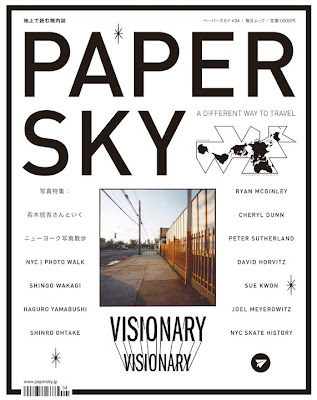
Papersky Issue 34: New York City: A Photographic Walk with Shingo Wakagi...

Saturday, November 27, 2010
Yomiuri column on revived anime/manga porn bill

SOFT POWER HARD TRUTHS / Tokyo govt's Barely-Offensive Content Act, Version 2.0
Roland Kelts / Special to The Daily Yomiuri
The Tokyo metropolitan government's bungled proposal earlier in the year to broaden its powers of censorship over manga and anime it deemed "harmful to minors" has been occasionally addressed in this column. The fuss started back in March, when a formal protest by manga artist luminaries was followed by similar objections from IT giants Google, Rakuten and others. By June, the legislation was flatly rejected, but not without a vow from Tokyo Gov. Shintaro Ishihara to revamp and try to push it through again this autumn.
The controversial Ishihara has his supporters and detractors. But like him or not, in this instance, there is no denying he is a man of his word.
Now we have Version 2 of the "nonexistent youth bill," so-called because of its opaque language promising to monitor depictions of fictional characters government officials decide are too young to be engaging in the fictional activities government officials decide are too harmful to real youth that government officials decide are too youthful to view or read about them. Ironies abound. Fictional portrayals of nonexistent young characters continue to proliferate as the financially strapped manga and anime industries cater to their largely middle-aged and male otaku core demographic, making more "moe," or soft-core porn imagery, in order to survive. Meanwhile, Japan's real youth are thin on the ground: The nation's notoriously declining birth rate is among the lowest in developed economies, and jobs for those youth who actually do exist in the form of university graduates have grown scarce. What's more, government officials are not doing much to help them.
The metropolitan government's latest efforts are being tracked by the indefatigable Tokyo-based translator Dan Kanemitsu, a half-Japanese writer whose blog, "Dan Kanemitsu's Paper Trail" is a font of cranky observation and excellent insight. According to him, Ishihara and Co. are trying to "sneak" the legislation into approval by making its language vaguer, its goals sanitized. The metropolitan government now aims to control what Kanemitsu calls "the danger posed by fiction that is not obscene, not extremely sexually stimulating, and not strongly prone to compel youth to conduct criminal acts, but is still harmful to youth because it deals with the subject of minors and sexuality in a realm of fiction, especially if presented in an 'anti-social' manner."
I phoned Kanemitsu in Tokyo on the eve of the unveiling of the latest redrafted proposal on Nov. 22. He remains deeply concerned about the legislation's stealthy, under-the-radar nature. "They're doing their best to not raise publicity," Kanemitsu tells me. "And they're doing their best not to [let anyone] examine [the legislation]. I think it's disingenuous, since it's something that could possibly have a lot of impact."
Japan's corrupt society of "press clubs" give voice to the major players who support them. The government issues a statement, journalists dutifully record it, and all bask in the glow of a brutally efficient PR release, disguised as journalism. Democracy, as someone once said, is messy. Japanese politicians and their docile toadies in the media don't like "messiness." Hence the latest step in government efforts to control what you see and read. "They want to go after three things," says Kanemitsu. "They want to go after shojo [girl's manga/anime], yaoi [manga/anime aimed at women and featuring beautiful men who love other men] and cheesecake [pornographic material aimed at men.] Under the existing regulations they could go after yaoi and cheesecake, but not porn. Japan's current penal code just says that we'll bust you if it's obscene, but it doesn't define what's obscene."
And there's the rub: Who defines what's "obscene," and how does one define it?
The question is even more relevant when one considers the winds of change in our clumsily globalized world. China is weighing in heavily on the question of authority, pressuring its trading partners not to participate in the Nobel Peace Prize ceremony in Norway owing to its clampdown on dissenters, one of whom was awarded this year's peace prize. Meanwhile, Western democratic freedom is manifest in images of British students and protesters smashing windows in central London in response to budget cuts.
Which world would you rather inhabit? "There are two groups of moralists in Japan," Kanemitsu explains. "One is the school teacher who is almost Catholic in stylization, very conservative, old-school Confucian. They are now mixed with progressives who have a feminist point-of-view, and who are anti-pornography more than anything. The old moralists want to make society go back in time; the new moralists want to banish all discrimination against women. But not all members of the Tokyo government want such repressive measures."
Not all. It's a small reed, but a worthy one. Not everyone wants to control what you see, read and hear, and not everyone mistrusts what you think and curate. But at least a small part of the goings-on in Tokyo involves all of us. How do you trust freedom, in its purest, most expressive forms, in a country that fears its own passions?
Thursday, November 25, 2010
Talking Turkey w/NHK about Akira


Murakami does Macy's, T-Day 2010


Tuesday, November 23, 2010
Chalmers Johnson, 1931-2010

By John Nichols, The Nation
Posted on November 22, 2010, Printed on November 23, 2010
http://www.alternet.org/story/148952/
With one word, "blowback," Chalmers Johnson explained the folly of empire in the modern age.
In the aftermath of the terrorist attacks of September11, 2001, true American patriots—as opposed to the jingoists and profiteers whose madness and greed would steer a republic to ruin—needed a new language for a new age.
They got it from Johnson. His 2000 book, Blowback,: The Costs and Consequences of American Empire (Macmillan), he took an old espionage term—which referred to the violent, unintended consequences of covert (and sometimes not so covert) operations that are suffered even by superpowers such as the United States—became an essential text for those who sought to explain the attacks and to forge sounder and more responsible foreign policies for the future.
Johnson, who has died at age 79, was no liberal idealist. He was the an old Asian hand who had chaired the Center for Chinese Studies at the University of California-Berkeley from 1967 to 1972 and then served as president and co-founder of the Japan Policy Research Institute. In other words, he was a man of the world who knew how the world worked. And what he tried to explain, to political leaders and citizens, was that the old ways of empire building (and maintaining) no longer worked in an age of instant communications, jet travel and doomsday weaponry.
"In Blowback, I set out to explain why we are hated around the world," Johnson explained in Nemesis: The Last Days of the American Republic, another of his series of three books on imperialism and empire, which became best sellers in the period after the 9-11 attacks. "The concept 'blowback' does not just mean retaliation for things our government has done to and in foreign countries. It refers to retaliation for the numerous illegal operations we have carried out abroad that were kept totally secret from the American public. This means that when the retaliation comes—as it did so spectacularly on September 11, 2001—the American public is unable to put the events in context. So they tend to support acts intended to lash out against the perpetrators, thereby most commonly preparing the ground for yet another cycle of blowback. In the first book in this trilogy, I tried to provide some of the historical background for understanding the dilemmas we as a nation confront today, although I focused more on Asia—the area of my academic training—than on the Middle East."
Johnson, a frequent contributor to The Nation in his later years, argued in his most impressive book, The Sorrows of Empire, that Americans needed to recognize something that their leaders denied: that the United States, a nation founded in opposition to empire, had become an empire.

"The Sorrows of Empire was written during the American preparations for and launching of the invasions and occupations of Afghanistan and Iraq," he explained. "I began to study our continuous military buildup since World War II and the 737 military bases we currently maintain in other people's countries. This empire of bases is the concrete manifestation of our global hegemony, and many of the blowback-inducing wars we have conducted had as their true purpose the sustaining and expanding of this network. We do not think of these overseas deployments as a form of empire; in fact, most Americans do not give them any thought at all until something truly shocking, such as the treatment of prisoners at Guantanamo Bay, brings them to our attention. But the people living next door to these bases and dealing with the swaggering soldiers who brawl and sometimes rape their women certainly think of them as imperial enclaves, just as the people of ancient Iberia or nineteenth-century India knew that they were victims of foreign colonization."
Johnson, in his last years, became a hero to old-right conservatives and new-left radicals, who recognized the truth of his observations about "the sorrows (of empire that are) already invading our lives, which (are) likely to be our fate for years to come: perpetual war, a collapse of constitutional government, endemic official lying and disinformation, and finally bankruptcy."
"The United States today is like a cruise ship on the Niagara River upstream of the most specacular falls in North America," Johnson warned. "A few people on board have begun to pick up a slight hiss in the background, to observe a faint haze of mist in the air on their glasses, to note that the river current seems to be running slightly faster. But no one yet seems to have realized that it is almost too late to head for shore. Like the Chinese, Ottoman, Hapsburg, imperial German, Nazi, imperial Japanese, British, French, Dutch, Portuguese, and Soviet empires in the last century, we are approaching the edge of a huge waterfall and are about to plunge over it."
Johnson knew his history—not just the history of empires that had fallen, but of the American experiment.
Many of his truest and most cherished reference points came from the republic's founding. We shared a passion for a James Madison's writings on the perils of imperialism in general. In particular, that passion took us to Madison's great 1795 line from Political Observations: "Of all the enemies of true liberty, war is, perhaps, the most to be dreaded, because it comprises and develops the germ of every other. War is the parent of armies; from these proceed debts and taxes; and armies, and debts, and taxes are the known instruments for bringing the many under the domination of the few. In war, too, the discretionary power of the executive is extended… War is in fact the true nurse of executive aggrandizement. In war, a physical force is to be created; and it is the executive will, which is to direct it. In war, the public treasuries are to be unlocked; and it is the executive hand which is to dispense them…”
Chalmers Johnson, a true son of the wisest and best of the founding generation, spoke the language of James Madison, when he argued that a republic could not maintain more than 700 military bases on foreign soil and retain its own freedom.
It was a Madisonian impulse that caused Johnson to warn us that: “As militarism, the arrogance of power, and the euphemisms required to justify imperialism inevitably conflict with America’s democratic structure of government and distort its culture and basic values, I fear that we will lose our country.”
It is a similarly Madisonian impulse, or what remains of it, that will cause genuine patriots to read Johnson as they do the founders for generations to come.
John Nichols is The Nation's Washington correspondent.
© 2010 The Nation All rights reserved.
Friday, November 12, 2010
Japan & Obama: humiliation & humbling


Obama in Japan: what a difference a bad year makes
Since the US president met with his Japanese counterpart last year, Obama has been belittled by voters, and Japan has been humiliated by its neighbors. Today, Japan and America need each other badly, and maybe more than ever.
President Obama arrived in Tokyo today, exactly one year to the day of his first official trip to Japan as commander-in-chief. He is here to attend the Asia Pacific Economic Cooperation summit in Yokohama, but his itinerary includes a brief “personal” excursion to the Great Buddha, a 44-foot tall bronze statue in Kamakura, which Mr. Obama first visited as a boy with his mother. While it is safe to say that the seven-and-a-half centuries old Buddha has changed very little since last November, or even since Mr. Obama’s childhood encounter, the state of his host nation has shifted significantly.
A different vision last year
Incoming Prime Minister Yukio Hatoyama wrote a provocative essay, published in translation in major US newspapers, advocating a new spirit of “fraternity” with Japan’s long-neglected Asian neighbors, citing the imminent end of America’s global leadership and implying that a decreasing reliance upon the US would be in his nation’s best interest.
IN PICTURES: Obama's Asia trip
Mr. Hatoyama’s essay caused predictable alarm in Washington. Its impact was compounded by conflict over the relocation of an American military base in Okinawa, Japan’s southernmost islands, which have hosted the bulk of US troops since the end of World War II.
The Japan that welcomed Mr. Obama just one year ago was celebratory but wary, and the president seemed alert to the schism, regaling his Tokyo audience with soft power stories about his boyhood Buddha visit and his love of green-tea ice cream while reminding them of the persistent military threats posed by North Korea and China.
What a difference a bad year makes. [more @CSM here]
Thursday, November 11, 2010
Far East to East Coast: Bo-Peep's kawaii killer rock

Monday, November 08, 2010
My review of "Butterfly's Sisters" for The Wall Street Journal


A Haunting Woman
By ROLAND KELTS
I was recently interviewed by an American television reporter about a popular simulated-dating videogame in Japan called Love Plus +. The game offers players a selection of cute virtual girlfriends for dates and relationships. Once the player has chosen his partner, the game's software constantly challenges him to find ever more effective ways of romancing her and keeping her happy.
At one point, the American reporter wondered why the virtual females in the game looked so young, docile and submissive. Was it OK in Japan, she asked me, a Japanese-American living in Tokyo, for men to pursue underage women?
It's not, of course. Like the famous Hello Kitty character, the game's girlfriends are designed to exemplify the Japanese cultural aesthetic of kawaii—adorably, irresistibly cute and dependent figures in need of attentive care and affection. It is precisely the "mincing, simpering personification of female subservience to the male" that abounds in stereotypes of Japan, according to Yoko Kawaguchi, a Japanese woman raised in North America. This misperception irritates Ms. Kawaguchi so much that she wrote a book about it.
Butterfly's Sisters
By Yoko Kawaguchi
Yale, 342 pages, $45
While "Butterfly's Sisters" is a sweeping historical account of Western impressions of Japanese women, it focuses on an icon that long preceded Hello Kitty and virtual girlfriends—the kimono-clad geisha. Ms. Kawaguchi is most interested in the era when Japan officially opened to Western trade and diplomacy in the mid-19th century. This period, she notes, marks "the beginning of the long-continuing debate over the precise nature of the geisha's occupation." In other words: "Were they or weren't they," as the book's first chapter-title asks, high-class prostitutes? [more @ WSJ]
Friday, November 05, 2010
Japan's American mangaka: Felipe Smith


SOFT POWER HARD TRUTHS / Galapagos vs global: Japan's American mangaka
Roland Kelts / Special to The Daily Yomiuri
Japan's "Galapagos syndrome," a phrase first coined to characterize the nation's highly evolved but globally incompatible cell phones, is lately being applied to other isolated industries, even to its people. "The Galapagosization of Japan continues," trumpeted one U.S. newspaper last month, when a survey of Japan's white-collar workers revealed that a full two-thirds of them never want to work abroad.
Such attitudes won't surprise anyone involved with Japan's producers of popular culture, whose minimal and often blinkered efforts to capitalize on the global appeal of their products have resulted in the downsizings, pinched margins and scant optimism plaguing Tokyo. Most of them are overworked, understaffed and underfunded; they don't have time to look up from their desks, let alone pay attention to the rest of the world.
Galapagosization is a two-way roadblock: Insiders cannot survive outside, outsiders cannot get in. Almost every one of those overburdened staffers is Japanese. "We have nothing to offer [foreign artists] here," says Shogakukan Co.'s Masakazu Kubo, veteran manga editor and executive producer of Pokemon. "That's shameful."
In 2007, Yukari Shiina set out to breathe new life into an industry she saw growing stale and self-absorbed. She founded the World-manga.com agency with the goal of introducing non-Japanese artists to domestic manga publishers, negotiating contracts and publicity between them. "I really wanted to bring some diversity into the Japanese industry," she says. "Diversity is one of the keys to survival. It's strange that we have tons of translated novels and films here, and Japanese love those works, mystery novels and Hollywood movies and Disney. But for some reason, we don't like the comics that others [like]."
Shiina surveyed the U.S. industry and found variety galore: Comics by non-U.S. artists are commonplace on the shelves and at conventions, and numerous nonnative born artists and employees work for U.S. publishers. Why not create a similar scenario in Japan?
It hasn't been easy. The language barrier, she says, is huge, "much bigger than I thought." In addition, the domestic manga business is strongly driven by fads and trends, with rapid turnover. The Internet may provide the illusion of greater proximity and transparency for overseas fans and artists, but trend spotting from thousands of kilometers away is inadequate. "People think that with the Internet you can follow everything, but that's just not true."
Thus far, the number of nonnative artists World-manga.com has managed to import and publish matches its years in operation: exactly three--hardly a trend of its own. Nevertheless, at least one of them has garnered considerable attention and praise, and his resume reads like a road map of diversity... [more here, and @ 3AM]
Thursday, November 04, 2010
Two friends, two films: NYC this Sat., 11-6